·4 min read
The sum of human knowledge, minus yours
Making it easier for AI to do meaningful work

·4 min read
by Phil Dearson
“We can know more than we can tell.”
Michael Polanyi, The Tacit Dimension (1966)
Previously at Volcano Base I’d been a bit poorly. Since then, I’ve been shuffling around muttering “oof, it’s hot”.
Mission Briefing: the sum of human knowledge, minus yours
Large language models were trained on “everything” humanity has written down. Medical literature, legal precedent, the complete works of Shakespeare, and an unknowable quantity of Reddit arguments. What they weren’t trained on is your company’s definition of a closed deal, the reason the orders table has a v2 suffix, or why one particular senior engineer is the only person who knows the join path between invoices and customers.
This is the context gap. It sits quietly between “the sum of human knowledge” and “what your finance team actually means by revenue”, and it’s where most AI deployments go to have a small, private crisis.
Google published something last week called the Open Knowledge Format. It’s a proposal to solve this: a standardised directory of markdown files describing what your data means, how it connects, and what an agent needs to know before it touches anything. The full specification fits on one page. No SDK, no vendor account, no uncomfortable conversation with a sales team. If it sounds similar to Karpathy’s approach, that’s because it is.
The underlying problem will feel familiar. I recently connected a client’s finance system, CRM, email marketing platform, and project management tool to Claude, so the team could ask natural language questions about the state of their business/project/pipeline/whatnot.
The technology was the easy part. Before any of it became useful, someone had to sit down and decide what things actually meant: what counts as a prospect versus a lead, how a deal moves through stages, which numbers the finance system trusts, what’s a project and what’s an initiative. The knowledge had to be assembled and structured before the agent could do anything useful with it.
OKF is one attempt to formalise that process and make it portable across tools, teams, and organisations. The format is less important than the habit it represents.
If you gave an AI agent complete access to your internal systems today, what would it find? Context, or archaeology?
Classified Intel
Anthropic is putting $150 million and 1,000 people where its mouth is
Anthropic has launched Claude Corps, a fellowship programme placing early-career workers with nonprofits for a year, paid $85k, to help them actually use AI. It’s either a genuinely smart hedge against the “AI ate our jobs” narrative, or a very expensive press release. Probably both. Worth watching because the shape of these programmes tends to predict where the industry thinks the political pressure is coming from next.
Claude Corps
A fictional 2031 in which Europe stopped mattering
Europe 2031 is a speculative scenario following an EU policymaker and a Silicon Valley founder watching the continent become a bystander to AI’s reshaping of geopolitics and the economy. It’s a thought experiment dressed as a cautionary tale, and it’s uncomfortably plausible. Relevant if you advise organisations who think “we’ll just use American AI tools” is a neutral business decision.
Europe 2031
Stop Killing the Internet
Stop Killing the Internet is a movement pushing back on age verification and monitoring proposals that campaigners argue would require surveillance infrastructure to enforce. The fight over who controls access to the internet is warming up again, and it will affect every business that relies on it. Relevant because the systems you run exist inside an infrastructure that is not as stable as it currently feels.
Stop Killing the Internet
Volcano Base is sponsored by ArcticStack from CoolCore
Enterprise-grade thermal resilience for the modern data estate.
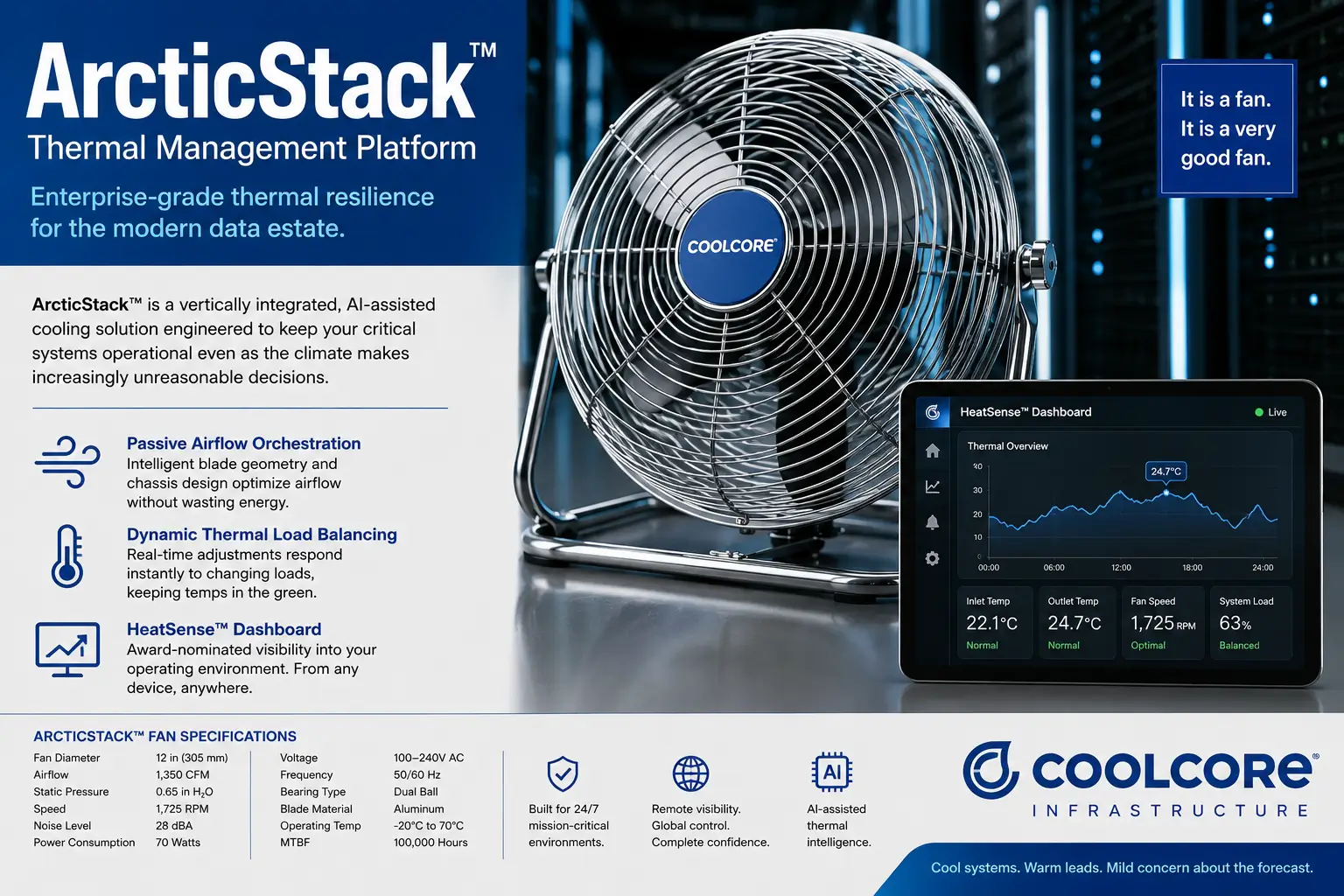
At CoolCore, we believe your uptime shouldn’t depend on the weather. That’s why we’ve developed our proprietary ArcticStack™ thermal management platform: a vertically integrated, AI-assisted cooling solution engineered to keep your critical systems operational even as the climate makes increasingly unreasonable decisions.
ArcticStack™ combines passive airflow orchestration, dynamic thermal load balancing, and our award-nominated HeatSense dashboard, giving you complete visibility into your operating environment from any device, anywhere.
It is a fan. It is a very good fan. The dashboard is real and it has a nice graph.
CoolCore Infrastructure. Cool systems. Mild concern about the forecast.